When companies start investing in warehouse automation, software terms can become confusing quickly. Two of the most commonly misunderstood systems are WCS and WES.
Both play an important role in helping warehouses, distribution centers, and fulfillment operations run more efficiently. But they are not the same.
In simple terms:
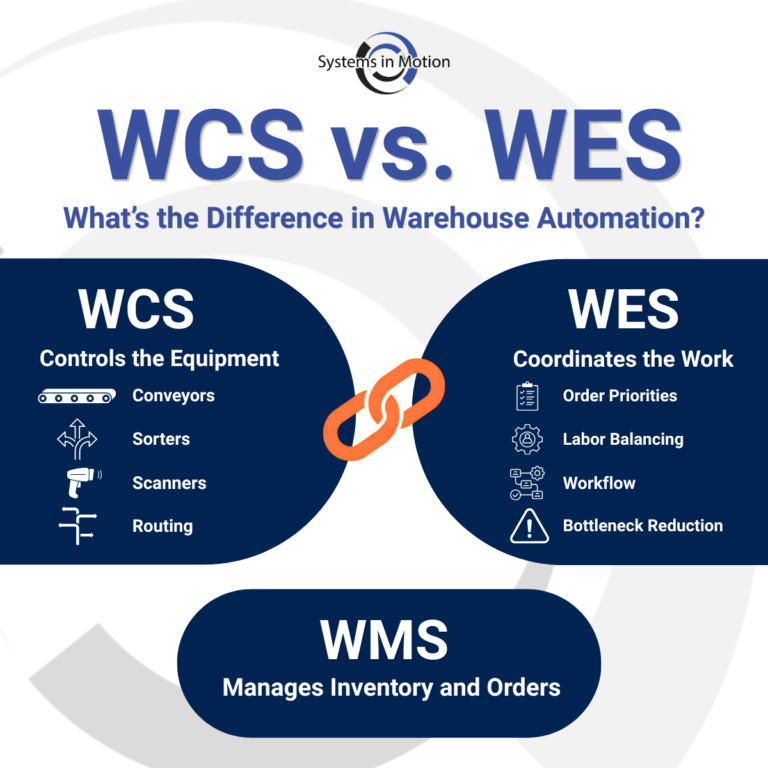
A WCS controls automated equipment. A WES coordinates warehouse work.
Understanding the difference between a Warehouse Control System and a Warehouse Execution System can help operations leaders make better decisions about automation, software integration, and long-term warehouse performance.
What Is a WCS?
A WCS, or Warehouse Control System, is software that controls and directs automated equipment inside a warehouse or distribution center.
A WCS is commonly used with automation systems such as:
- Conveyor systems
- Sorters
- Scanners
- Print-and-apply systems
- Palletizers
- Robotics
- AS/RS systems
- Automated storage and retrieval equipment
The main job of a WCS is to make sure equipment knows what to do in real time.
For example, if a carton is traveling through a conveyor system, the WCS helps determine where that carton should go, when it should be scanned, and which lane, sorter, or shipping area it should be routed to.
In plain terms, a WCS is focused on equipment control and product movement.
A WCS helps answer questions like:
- Where should this carton go?
- Which conveyor lane should it use?
- When should the sorter divert the package?
- Is the automation running correctly?
- How do we keep products moving through the system?
For highly automated facilities, the WCS is a critical layer between warehouse software and physical equipment.
What Is a WES?
A WES, or Warehouse Execution System, is software that helps coordinate warehouse work in real time.
While a WCS focuses on controlling equipment, a WES focuses on managing the flow of work across the operation.
A WES can help prioritize orders, release work to different areas of the warehouse, balance labor, coordinate automation, and reduce bottlenecks.
In plain terms, a WES is focused on workflow execution and operational decision-making.
A WES helps answer questions like:
- Which orders should be released first?
- Where is labor needed most right now?
- Is one area of the warehouse getting backed up?
- Should work be redirected to another zone?
- How do we balance speed, capacity, and shipping deadlines?
A WES is especially useful in operations with multiple processes happening at the same time, such as picking, replenishment, packing, sorting, and shipping.
WCS vs. WES: The Simple Difference
The easiest way to understand WCS vs. WES is this:
WCS controls the automation. WES manages the work.
A Warehouse Control System tells equipment what to do.
A Warehouse Execution System decides what work should happen, when it should happen, and how to keep the operation balanced.
Here’s a simple example.
An order needs to be picked, packed, and shipped today. The WES may decide when that order should be released based on order priority, labor availability, shipping deadlines, and current workload.
Once that order is picked and placed onto a conveyor, the WCS helps control how the carton moves through the system. It determines when it gets scanned, where it diverts, and which shipping lane it reaches.
Both systems support warehouse efficiency, but they operate at different levels.
How WCS and WES Work Together
In many modern warehouse automation systems, WCS and WES work together.
The WES manages the bigger picture of warehouse activity. The WCS handles the real-time control of equipment and product movement.
Think of the WES as the traffic manager and the WCS as the system controlling the traffic lights, lanes, and signals.
The WES says, “This work needs to move now.”
The WCS makes sure the equipment moves it correctly.
When properly integrated, WCS and WES software can help improve throughput, reduce downtime, increase visibility, and keep warehouse operations running more smoothly.
Where Does a WMS Fit In?
To fully understand WCS vs. WES, it also helps to understand the role of a WMS, or Warehouse Management System.
A WMS typically manages inventory, orders, receiving, putaway, picking, and shipping at a higher level. It is often the system of record for what inventory is in the building and what needs to be fulfilled.
A WES helps execute and prioritize work in real time.
A WCS controls the automated equipment that physically moves products through the facility.
A simple way to look at it is:
WMS = What inventory and orders do we have?
WES = What work should happen next?
WCS = How does the equipment move it?
In many facilities, the WMS, WES, and WCS need to communicate with each other to create a smooth, efficient warehouse automation environment.
Do You Need a WCS, WES, or Both?
Whether you need a WCS, WES, or both depends on your operation.
If your facility uses conveyors, sorters, robotics, AS/RS, or other automated material handling equipment, a WCS may be needed to control that equipment and keep products moving correctly.
If your operation struggles with order prioritization, labor balancing, wave release, bottlenecks, or real-time decision-making, a WES may be a better fit.
Some warehouses need both systems. Others may only need one, depending on the complexity of the operation, the level of automation, and the challenges they are trying to solve.
The best place to start is by identifying the main problem.
If the issue is equipment control, routing, or automation communication, you may need a WCS.
If the issue is workflow coordination, order release, labor balance, or operational visibility, you may need a WES.
If the issue is inventory management, order accuracy, or receiving and shipping processes, you may need to evaluate your WMS.
Why Understanding WCS vs. WES Matters
Choosing the right warehouse software matters because the wrong system can create more complexity instead of solving the real problem.
For example, adding more automation will not fix a poor order release strategy. At the same time, improving workflow planning will not help if the equipment cannot properly route, scan, or divert products.
That is why it is important to understand the specific role of each system.
A WCS helps automation run correctly.
A WES helps warehouse work flow efficiently.
A WMS helps manage inventory and orders.
When these systems are aligned, warehouse operations can become faster, more accurate, and easier to manage.
WCS vs. WES in Plain Terms
WCS and WES are both important parts of modern warehouse automation, but they solve different problems.
A Warehouse Control System controls the equipment that moves product through the warehouse.
A Warehouse Execution System coordinates the work that needs to happen across the operation.
In simple terms:
WCS = Equipment control
WES = Work coordination
WMS = Inventory and order management
For companies evaluating warehouse automation software, the key is not just choosing more technology. The key is choosing the right technology for the problem you are trying to solve.
Systems in Motion helps companies evaluate, integrate, support, and optimize warehouse automation systems. Whether you are trying to improve throughput, reduce bottlenecks, upgrade legacy equipment, or better connect your warehouse software and automation, the right partner can help you build a system that works together.