
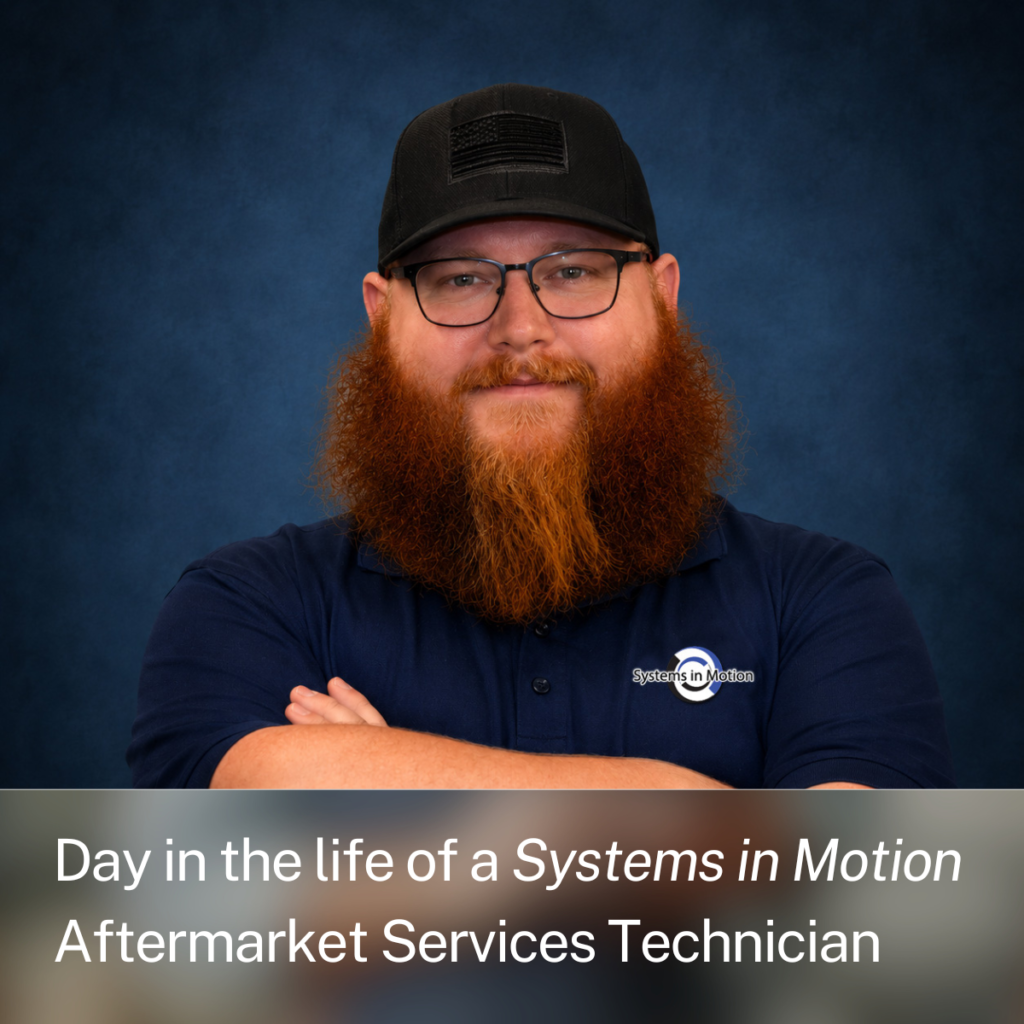
Inside the Day of a Systems in Motion Technician
Behind Every Running Conveyor Is Someone Keeping It That Way When a conveyor stops, operations slow down. Orders back up. Productivity suffers. That’s why Systems in Motion’s field service technicians are on the road every day, helping customers keep their operations moving. Christian Blair has been doing exactly that for nearly eight years as a Service Technician at Systems in Motion. Before joining the service team, he spent three years building conveyor systems, giving him firsthand knowledge of how they’re designed and how they operate. That experience naturally led him into field service, where he now helps customers troubleshoot, repair, and maintain material handling systems. Christian’s workday usually begins around 6:00 a.m. Before heading to a customer site, he checks his service van, making sure everything is ready for the day from vehicle safety to having enough fuel to reach the jobsite. His tools stay stocked and organized so he’s prepared whenever a service call comes in. No two service calls are exactly alike. When Christian arrives on-site, his first step isn’t grabbing a wrench it’s talking with the customer. He meets with the site’s point of contact, listens carefully to the symptoms they’re experiencing, and immediately begins building a mental checklist of possible causes. From there, he diagnoses the issue, identifies the root cause, and works through the repair until the equipment is operating properly again. While Hytrol conveyor systems are among the equipment he services most frequently, many of the issues he encounters are surprisingly simple. “Mostly photo eyes,” Christian says. “A lot of misaligned photo eyes.” One recent service call demonstrates the importance of careful troubleshooting. A customer reported that a belt had come off track on a multi-belt sorter. After inspecting the system, Christian discovered the belt had flipped upside down after likely becoming jammed by product. Rather than simply reinstalling the belt, he inspected the entire conveyor, corrected the issue, verified the belt tracked properly, and confirmed there were no underlying mechanical problems that could cause it to happen again. It’s this attention to detail that helps prevent repeat failures. For Christian, minimizing downtime means making sure the repair is complete the first time. “My job is fully complete, and I don’t get called back out between PMs,” he says. Many customers are surprised to learn that the job extends well beyond conveyors. “It involves more than just conveyor,” Christian explains. Service technicians often troubleshoot controls, mechanical systems, sensors, safety devices, and equipment from multiple manufacturers. During repairs, they also identify additional wear or damage that could lead to future failures if left unaddressed. Every repair begins with protecting people before equipment. For Christian, lockout/tagout procedures are one of the most important parts of every job. Once repairs are complete, he walks back through each step of the work to verify components were reassembled correctly and that the equipment is ready to safely return to service. Documentation is equally important. Service reports summarize the work completed and provide customers with a clear record of the repairs performed, while Systems in Motion’s Coast platform helps technicians capture photos and service information for future reference. After nearly eight years in the field, Christian says the most valuable tools aren’t just in his toolbox. “Years of knowledge.” That experience, combined with power tools and digital service platforms like Coast, allows him to diagnose problems faster and help customers get back up and running sooner. He also relies on diagnostic checklists developed by the Aftermarket Services team to guide customer conversations and identify simple solutions before more extensive repairs are needed. One of Christian’s favorite projects has been supporting the KeHE facility in Ellettsville. “I was part of the installation, and now I’m part of the aftermarket service.” Seeing a system through its entire lifecycle from installation to ongoing maintenance gives technicians a unique perspective on how customers operate and how preventative service can extend the life of their investment. The relationships built along the way are equally rewarding. Christian recalls receiving positive feedback from customers after not only solving problems but also taking the time to explain how equipment works and how they can troubleshoot issues themselves. When asked what people don’t realize about being a field service technician, Christian’s answer is simple. “You’re there till the job’s done.” It’s a role that requires technical knowledge, problem-solving, physical endurance, and a commitment to customer success. Whether working in tight spaces, traveling across the country, or responding to unexpected breakdowns, Systems in Motion technicians are focused on one goal: Keeping customers running. At Systems in Motion, our Aftermarket Services team supports material handling systems with preventative maintenance, emergency service, repairs, and technical expertise helping facilities reduce downtime and maximize equipment performance. Learn more about our Aftermarket Services: https://systemsinmotion.com/technology-solutions/aftermarket-services/
Inside the Day of a Systems in Motion Technician Read More »